
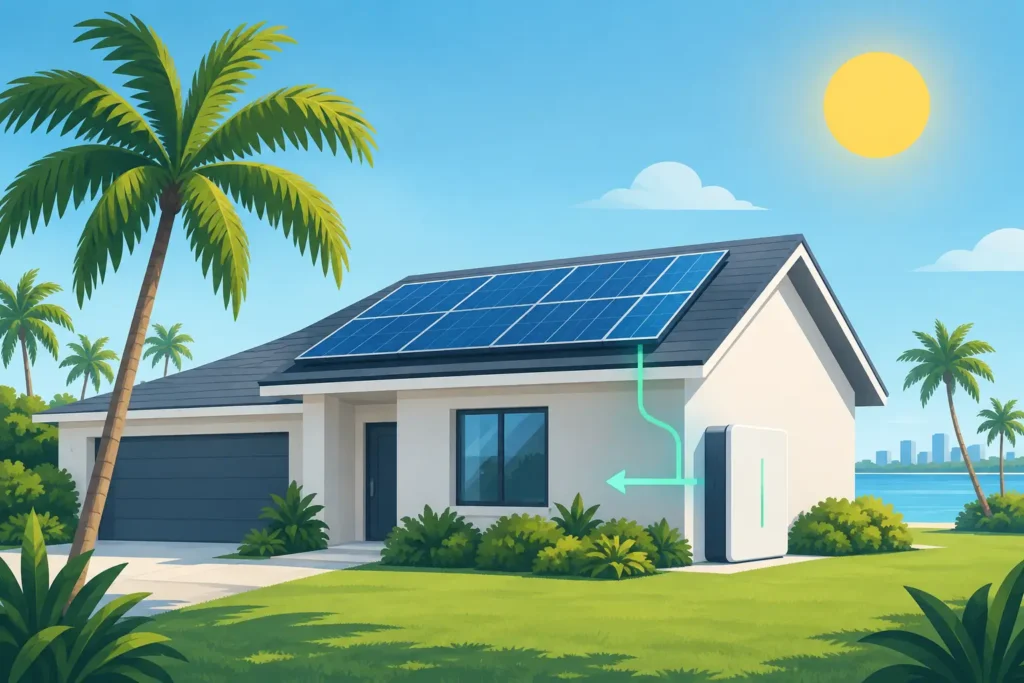
A sunny Florida afternoon can turn into a power outage before dinner. When a storm knocks out the grid, solar panels alone may not keep your lights, refrigeration, internet, or essential business equipment running. This solar battery guide explains how battery storage works, what it can realistically power, and how to choose a system that protects your property when conditions change fast.
For homeowners, battery storage can mean less disruption during hurricane season and more control over how solar energy is used after sunset. For commercial properties, it can support critical loads, reduce downtime, and add another layer of resilience to a building already protected by a dependable roof and exterior system.
What a Solar Battery Actually Does
Solar panels generate electricity when sunlight is available. Without a battery, most grid-tied solar systems send excess production to the utility grid and draw electricity back when the panels are not producing enough. That arrangement can lower utility costs, but it does not automatically provide backup power during an outage.
A solar battery stores electricity generated by your panels or, in some cases, electricity pulled from the grid during lower-cost periods. When the grid goes down, a properly designed battery system can power selected circuits or, with enough capacity and the right equipment, much of the property.
The key component is not just the battery itself. Your system also needs compatible inverters, controls, and an automatic transfer device that safely separates your property from the utility grid during an outage. This protects utility workers and allows your solar-and-battery system to operate independently until grid power returns.
Solar Battery Guide: Start With Your Backup Priorities
The right question is not, “How many batteries do I need?” It is, “What must stay on when the power is out?” A battery sized for a few essentials is very different from one designed to operate an entire home or commercial building.
Most homeowners prioritize refrigeration, lighting, internet equipment, phone charging, a garage door opener, security equipment, and a few outlets. In Florida, many also want a well pump, medical equipment, or a small number of cooling loads protected. Central air conditioning is possible to back up, but it can require substantially more battery capacity and careful equipment selection because air conditioners use significant power, especially at startup.
For a business, priorities may include emergency lighting, network equipment, refrigeration, point-of-sale systems, security cameras, gate controls, server equipment, or designated office circuits. A restaurant, medical office, or property with temperature-sensitive inventory may have very different backup needs than a retail store or professional office.
A good installer reviews your actual electrical usage, identifies high-demand appliances, and builds a backup plan around the loads that matter most. Trying to power everything can drive up cost quickly. Protecting the right circuits often delivers stronger value and longer backup time.
Capacity and Power Are Not the Same
Battery proposals often reference two measurements: kilowatt-hours and kilowatts. They are related, but they answer different questions.
Kilowatt-hours, or kWh, measure stored energy. Think of this as the size of the fuel tank. More kWh generally means more hours of runtime. A battery with 13.5 kWh of usable storage may cover essential household loads overnight, but runtime depends entirely on what is operating.
Kilowatts, or kW, measure power output. This is the amount of electricity the battery can deliver at one time. A system may have enough stored energy for many hours but still be unable to start several large appliances simultaneously if its power output is too low.
Your system must be designed for both. A household running a refrigerator, lights, router, television, and several chargers has a much different demand profile than one starting a central HVAC system, electric range, pool pump, and clothes dryer.
How Long Will a Battery Run?
There is no honest one-size-fits-all answer. Battery runtime depends on usable storage capacity, the total electrical load, weather conditions, and whether solar panels can recharge the battery during the day.
As a simple example, a 10 kWh usable battery supplying an average 1 kW load could theoretically run for about 10 hours. Real-world results will vary because appliances cycle on and off, battery systems have conversion losses, and power use can spike unexpectedly.
During an extended outage, solar production makes a major difference. On clear days, panels can recharge the battery while also powering daytime loads. But storm conditions can reduce production, and a battery should never be sized on the assumption that every outage day will be bright and cloud-free.
This is why load management matters. Smart controls can temporarily limit nonessential equipment, helping stored energy last longer. Turning off a pool pump, avoiding electric cooking, and setting practical cooling expectations can stretch backup power considerably.
What Solar Battery Storage Costs in Florida
The installed cost of a solar battery system varies based on battery capacity, brand, inverter requirements, electrical upgrades, permitting, labor, and whether the project includes new solar panels or adds storage to an existing system. Whole-home backup and multi-battery systems cost more because they require more equipment and more detailed electrical planning.
Rather than comparing proposals by battery price alone, compare the usable capacity, continuous power output, backed-up circuits, warranty terms, installation scope, and expected future expansion options. A lower initial price can be less valuable if the system cannot support the loads you need during an outage.
Financing may make battery storage more manageable for qualified property owners. Federal incentives may also apply to eligible battery installations, but tax rules and eligibility can change. Speak with a qualified tax professional before counting on a specific credit in your project budget.
Battery Placement, Safety, and Florida Weather
Florida heat, humidity, driving rain, salt air in coastal areas, and storm exposure all deserve attention during system design. Batteries and supporting equipment need an approved location with proper clearances, ventilation where required, and protection from physical damage and water intrusion.
Placement may be indoors, in a garage, on an exterior wall, or in another approved location, depending on the equipment and local code requirements. The best location is not simply the closest wall to the electrical panel. It must support safe access, code compliance, efficient wiring, and long-term performance.
For coastal and storm-prone properties, mounting methods, equipment ratings, conduit routing, and roof penetrations all need to be handled carefully. Solar equipment should complement your roof system, not create weak points in it. Coordinating solar and roofing work under one experienced contractor can reduce scheduling conflicts and help protect the integrity of the entire exterior.
Should You Add a Battery to Existing Solar?
Often, yes. Many existing solar systems can be upgraded with battery storage, though compatibility matters. Some systems may require a new inverter, additional control equipment, or changes at the main electrical panel. Older systems can be more complex, so an on-site assessment is the right place to start.
If your roof is nearing the end of its service life, consider the timing carefully. Removing and reinstalling panels later can add cost and delay. Planning a roof replacement and solar upgrade together can be a smarter long-term investment, especially when you want to avoid disrupting a new solar system soon after installation.
For new construction, roof replacement, or major exterior renovations, battery-ready solar planning gives you more flexibility. Even if you install panels first and add storage later, designing the electrical system with future expansion in mind can prevent avoidable rework.
Questions to Ask Before You Buy
Ask each installer exactly which circuits will receive backup power and how long they are expected to run under normal use. Confirm whether the proposal supports partial-home backup, whole-home backup, or only a limited critical-load panel.
Also ask about battery warranty coverage, usable capacity, power output, expansion capability, monitoring, permitting, utility requirements, and who will service the system if a problem occurs. For commercial owners, ask how the design protects critical operations and whether shutdown procedures are clear for staff.
Florida’s Roofing & Construction Group approaches solar storage as part of property protection, not as a one-size-fits-all add-on. A clear assessment of your roof condition, electrical needs, energy goals, and outage priorities helps ensure the system is built for the way you actually live or operate.
A solar battery will not eliminate every concern during a major storm, and it cannot replace sensible preparation. But a properly designed system can give your property a dependable reserve when the grid is unavailable. Start by deciding what you cannot afford to lose power to, then build a solar battery plan around protecting it.