
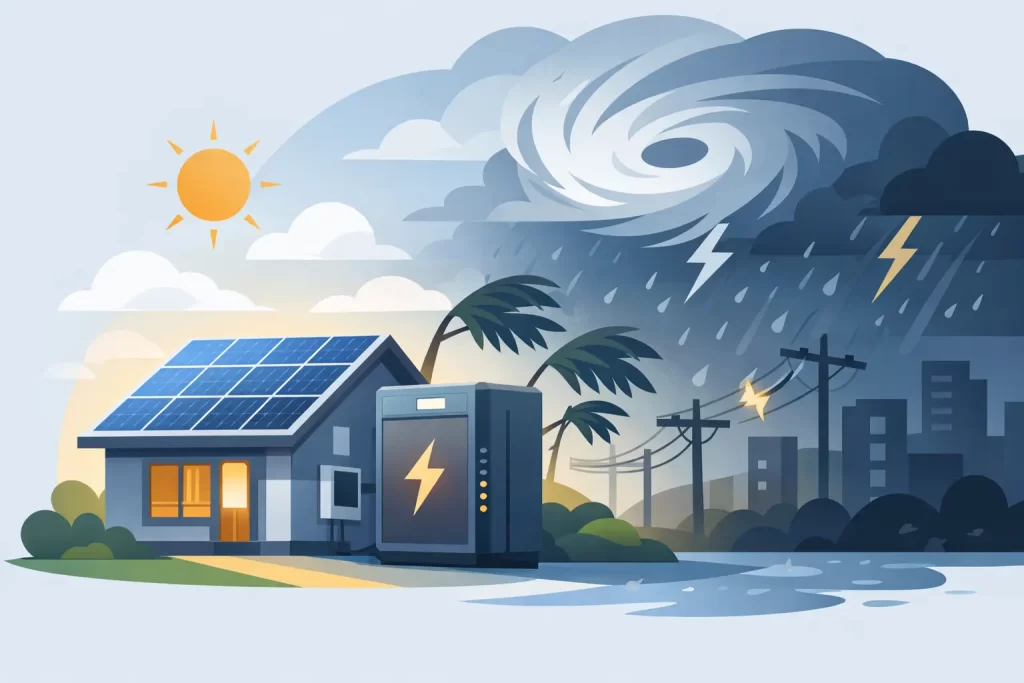
A Florida outage can last far longer than the storm itself. After hurricane-force winds pass, families may face days without refrigeration, air conditioning, communications, or a way to keep medical equipment running. Solar battery backup for hurricane outages gives your property a planned source of power when the grid is down – but only when the system is designed around what you truly need to keep operating.
For homeowners and business owners, the goal is not necessarily to power every circuit indefinitely. It is to protect the essentials, reduce disruption, and avoid making critical decisions after a storm has already arrived.
Why Solar Panels Alone Do Not Provide Outage Power
Many property owners assume solar panels will continue producing electricity whenever the sun comes out after a storm. In a standard grid-tied solar setup, that is usually not the case. When utility power fails, the solar inverter shuts down as a safety measure. This protects line crews working to restore power and prevents electricity from feeding back into damaged utility lines.
A battery changes the equation. With battery storage, the system can disconnect from the grid and create a controlled source of power for selected circuits in the home or business. During daylight hours, solar panels can help recharge the battery. At night or during heavy cloud cover, the battery carries the load until it needs more solar production or grid power returns.
That distinction matters in Florida. Panels can lower electric bills, but panels plus battery storage can provide a measure of independence during an outage.
Start With the Loads You Cannot Lose
The right backup system starts with a practical conversation about priorities, not a generic battery size. A homeowner may need refrigeration, a few lights, internet service, phone charging, a well pump, garage access, and one small air-conditioning unit. Another household may have medical equipment or a sump pump that must remain powered.
For a business, the priority may be keeping security systems, emergency lighting, internet equipment, refrigeration, point-of-sale systems, or a limited number of office circuits operating. A restaurant, medical office, property management company, or facility with temperature-sensitive inventory may need a more detailed continuity plan.
Air conditioning is often the biggest consideration. Central HVAC systems use significant power, particularly when they start. A battery can support air conditioning in some designs, but running an entire large home or commercial building at normal capacity for days requires substantial storage and a carefully planned electrical setup. A better approach may be backing up one high-efficiency mini-split, a smaller designated comfort zone, or essential ventilation rather than every thermostat zone.
A qualified installer should review your electrical panel, major appliances, daily energy use, roof layout, and expected backup priorities. That prevents the common mistake of buying a battery based on a single advertised capacity number without understanding how long it will actually last.
How Much Battery Capacity Do You Need?
Battery capacity is typically measured in kilowatt-hours, or kWh. That figure describes how much energy the battery can store, but it does not tell the whole story. The usable capacity, battery output, solar production, appliance startup demand, and the number of circuits being backed up all affect real-world performance.
A modest essential-load system may keep refrigeration, lighting, internet, electronics, and select outlets running through an overnight outage. A larger system can support more appliances and can recharge during daylight, extending protection over multiple days if sunlight is available and usage is managed.
The duration depends on conditions. A battery used sparingly during a sunny period may last much longer than the same battery powering air conditioning, electric cooking, pool equipment, and multiple refrigerators during several cloudy days. Hurricane season also brings a practical challenge: clouds, rain, debris, and shading can reduce solar production precisely when backup power is needed most.
That is why capacity should be viewed as part of a complete system. More solar generation can help replenish storage. Additional batteries can extend runtime. Load management can keep high-demand equipment from draining the system too quickly. In some cases, a generator may still make sense as a secondary layer for extended outages or larger commercial loads.
Protecting the Equipment Before the Storm
Backup power equipment must be installed with Florida weather in mind. Solar panels and mounting components need to be engineered and secured for local wind conditions. Roof penetrations must be properly flashed and sealed so the solar installation does not compromise the roof system beneath it. Battery equipment, inverters, disconnects, and electrical components should be located and protected according to manufacturer requirements and applicable codes.
This is where a contractor who understands both roofing and solar can make a meaningful difference. A solar project should never treat the roof as an afterthought. If a roof is nearing the end of its service life, has existing storm damage, or needs repairs around penetrations, addressing those concerns before panel installation can prevent costly removal and reinstallation later.
Battery location also deserves attention. Flood exposure, heat, clearance requirements, access for maintenance, and local permitting all matter. A system that looks simple on a sales proposal can become complicated if equipment placement is not evaluated carefully at the property.
Before hurricane season, inspect visible equipment for damage, keep the area around batteries and electrical gear clear, and make sure household members know which backed-up circuits are available. Keep the monitoring app active if your system includes one, but do not rely on an app as your only plan. A printed list of priority loads and basic operating instructions is useful when cell service is spotty or a phone battery is low.
Solar Battery Backup for Hurricane Outages: Planning for Reality
The best solar battery backup for hurricane outages is designed for the outage you are likely to experience, not an idealized one. It should account for a day or more of heavy clouds, the possibility that solar panels are covered by leaves or branches, and the fact that roads may be blocked before service crews can reach your neighborhood.
It should also fit your property type. A single-family home may benefit from a dedicated critical-load panel. A larger home may need whole-home backup with intelligent load controls. A commercial facility may need a phased plan that protects life-safety equipment and business-critical operations first, then expands capacity as budgets allow.
Not every system needs to be built to cover every imaginable outage. Oversizing can increase project cost dramatically. Undersizing can leave you disappointed when the battery runs out after a few hours. The right balance comes from defining what comfort, safety, and continuity mean for your household or operation.
Financing may also influence the design. Some owners choose to install solar panels and an initial battery now, then add storage later as needs and budget allow. Others prefer to complete roofing, solar, and battery work together to coordinate installation, protect warranties, and avoid reopening finished work.
Do Not Forget the Rest of the Hurricane Plan
Battery backup is one part of property protection, not a replacement for it. A secure roof, working gutters, protected windows, trimmed trees, and a well-maintained exterior all reduce the chance that storm damage turns an outage into a larger emergency.
Keep refrigerators and freezers closed as much as possible during an outage. Turn off nonessential high-demand appliances. Charge phones and battery-powered tools before landfall. If you use a portable generator as part of your plan, operate it outdoors and well away from doors, windows, and vents. Never connect a generator directly to a home electrical system without the proper transfer equipment.
For business properties, document shutdown and restart procedures before hurricane season. Identify who can access electrical rooms, review alarm and refrigeration priorities, and make sure key employees know how to communicate if normal systems are unavailable.
A well-designed solar and battery system gives you more than backup electricity. It gives you options when utility restoration is uncertain. If you are considering storage alongside a roof replacement, solar installation, or broader storm-readiness project, Florida’s Roofing & Construction Group can help assess the roof, electrical priorities, and installation path before the next forecast demands your attention.