
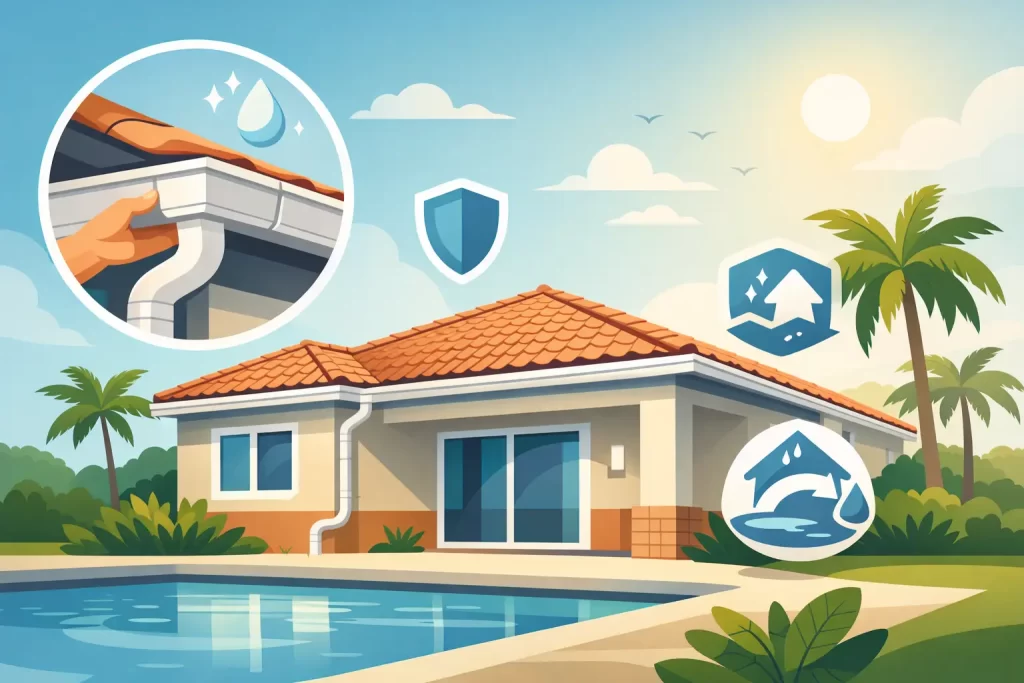
A Florida downpour can expose a weak drainage system in minutes. The seamless gutter installation benefits that matter most are practical: fewer places for water to escape, better control of roof runoff, and stronger protection for the foundation, siding, landscaping, and entryways below.
For homeowners and property managers, gutters are not an afterthought. They are part of the exterior protection system. When they are sized correctly, securely installed, and kept clear, they move large volumes of water away from the building before it can create expensive problems.
Why Seamless Gutter Installation Benefits Matter in Florida
Florida roofs shed a great deal of water during summer storms, tropical systems, and sudden afternoon rain. If that water pours over the gutter edge or spills through failing joints, it can saturate the soil around the building, stain exterior walls, damage soffit and fascia materials, and erode landscaping.
Traditional sectional gutters are assembled from multiple pieces. Each connection is a potential point of failure as sealant ages, debris builds up, or the gutter shifts under the weight of standing water. Seamless gutters are custom formed to the length of each roofline, so the long runs have no joints. They still have connections at corners, downspouts, and end caps, but there are far fewer seams overall.
That difference is especially valuable when a property must handle repeated heavy rain. Less reliance on sealed joints means fewer locations where leaks are likely to develop over time.
Fewer Leaks Protect More Than the Roofline
A small gutter leak may look minor from the ground, yet its effects can spread. Water that continually runs behind a gutter can rot fascia boards, damage soffits, and create conditions that invite mold growth and pest activity. Water that falls in one concentrated spot can also wash away mulch, undermine pavers, or create muddy areas near walkways.
Custom-formed gutters reduce the number of joints along straight roof edges. This gives rainwater a smoother path toward the downspouts and reduces maintenance concerns associated with repeated sealing and patching. Proper installation remains essential. Even a quality gutter can fail if it has poor slope, weak hangers, undersized downspouts, or an incorrect placement under the roof edge.
For commercial buildings, the same principle applies on a larger scale. Reliable drainage helps protect exterior walls, loading areas, entrances, and the landscaping that shapes a property’s appearance. It can also reduce slip hazards caused by uncontrolled runoff near pedestrian routes.
Better Water Control Helps Protect Foundations
Gutters do their best work when they do not simply collect water, but direct it well away from the structure. Downspouts should discharge in locations that prevent water from pooling beside the foundation. Depending on the site, this may involve extensions, underground drainage, splash blocks, or a carefully planned grading solution.
Foundation issues are not always caused by one storm. More often, they develop after repeated cycles of water collecting in the same place. Saturated soil can contribute to settlement, cracking, drainage problems, and moisture intrusion in garages, crawl spaces, or lower-level rooms.
This is why gutter installation should be evaluated as part of the whole exterior. The roofline, fascia condition, roof drainage pattern, landscaping, ground slope, and downspout placement all affect the result. A trusted exterior contractor can identify whether the gutter problem is truly the gutter itself or a sign of roof damage, failing fascia, or drainage issues around the property.
A Custom Fit Improves Appearance and Performance
Seamless gutters are fabricated on site to match the measurements of the building. That custom fit gives the system a clean, continuous appearance that works well with both residential and commercial exteriors. With a range of color options available, gutters can blend with the fascia, trim, roof, or siding instead of looking like an obvious add-on.
Appearance is not just cosmetic. A gutter system that sits straight and is attached properly is better positioned to handle water flow and resist sagging. Quality hangers, correct spacing, and a stable attachment surface all help the system stay secure during severe weather.
Aluminum is a popular material because it is lightweight, corrosion-resistant, and available in many colors. However, the right choice depends on the property and budget. Copper offers a distinctive look and long service life, but it costs more. Steel can be strong, though it requires careful attention to corrosion protection in Florida’s humid and coastal environments.
Less Maintenance Does Not Mean No Maintenance
One of the strongest benefits of seamless gutters is that they generally require less joint-related upkeep than sectional systems. That does not mean they can be ignored. Leaves, pine needles, shingle granules, seed pods, and storm debris can still block water flow. A clogged downspout can cause water to back up, overflow, and put unnecessary weight on the gutter.
Regular inspections are a smart part of property maintenance, particularly after severe weather. Look for overflowing water, sagging sections, peeling paint near the roof edge, soil erosion below downspouts, and water stains on siding or soffits. These signs can point to drainage trouble before it becomes a larger repair.
Gutter guards may help reduce debris buildup for some properties, but they are not a universal answer. The right guard depends on the surrounding trees, roof type, local debris, and the ability to maintain the system. Guards can reduce cleaning frequency, but homeowners should still inspect gutters and downspouts after major storms.
Proper Sizing Is Critical During Heavy Rain
A beautiful gutter system that is too small for the roof area will still overflow during intense rain. Florida properties often need a drainage plan based on roof pitch, roof square footage, valleys, and the amount of water concentrated into certain sections. Large roof planes and roof valleys can send a surprising amount of runoff into one area.
A professional installer can determine whether standard five-inch gutters are appropriate or whether six-inch gutters and larger downspouts are the better choice. This is not a place to guess. Increasing gutter capacity may be the difference between water staying inside the system and water pouring over the edge during the storms that test it most.
For homes with multiple roof levels, patios, lanais, or screened enclosures, drainage planning deserves even closer attention. Water should not be redirected toward doors, pool decks, air-conditioning equipment, or areas where it can create erosion and standing water.
When Replacement Makes More Sense Than Repair
Minor issues such as a loose hanger or a clogged downspout can often be corrected quickly. But replacement is usually the better long-term value when gutters have recurring leaks, widespread corrosion, multiple sagging sections, damaged fascia attachment points, or persistent overflow despite cleaning.
It may also make sense to replace gutters during a roof replacement. This gives the contractor an opportunity to inspect the roof edge, fascia, drip edge, and drainage layout while the project is underway. Coordinating exterior work can reduce disruption and help ensure the finished roof and gutter system work together.
Florida’s Roofing & Construction Group helps property owners approach these decisions with a complete exterior perspective. A clear assessment should explain what is causing the problem, what work is recommended, and how the solution will protect the property through the next storm season.
Choose Installation, Not Just Gutters
The product matters, but installation determines much of the system’s performance. Ask whether the contractor will inspect fascia condition, establish the correct slope, secure gutters with durable hangers, size downspouts for the roof’s runoff, and direct discharge away from the foundation.
Also ask about workmanship coverage, material options, project timing, and the condition of nearby roof components. Upfront answers make it easier to compare estimates based on long-term protection rather than the lowest initial price.
When rain is beating against the roof, a properly designed gutter system gives water one clear job: move away from the building. That simple function can help preserve the exterior, protect the ground around it, and give you greater confidence before the next Florida storm arrives.