
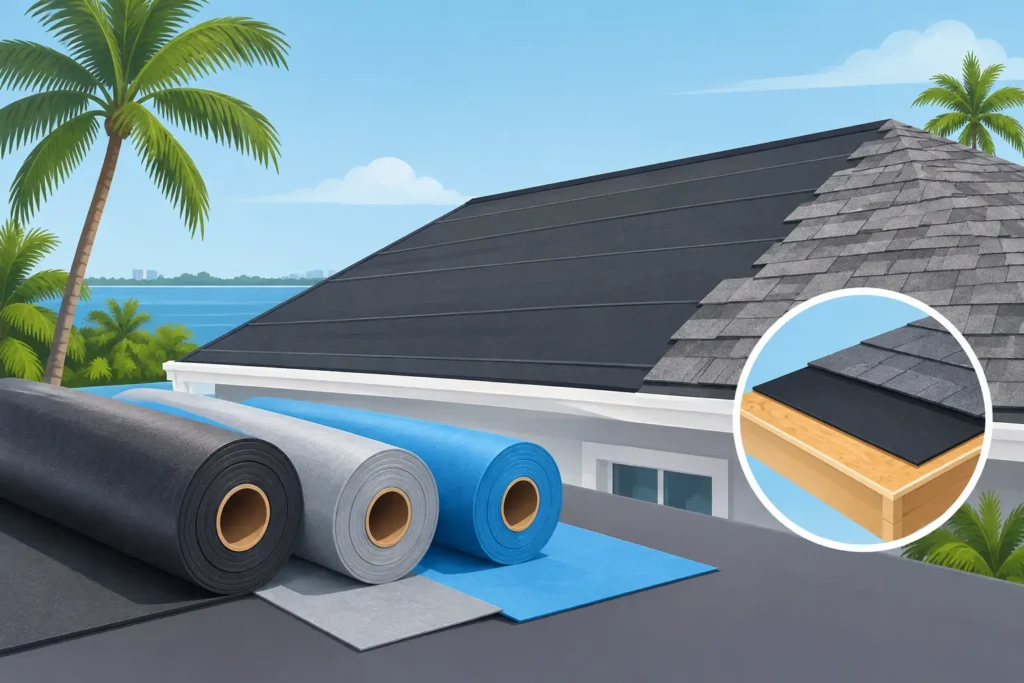
A new roof can look flawless from the street and still be vulnerable beneath the shingles or metal panels. Roof underlayment is the secondary water-shedding layer installed between the roof deck and the exterior roofing material. Knowing how to choose roof underlayment matters in Florida because wind-driven rain, intense sun, humidity, and hurricane-season storms can expose weaknesses that a mild climate may never reveal.
The right choice is not simply the most expensive roll available. It needs to fit your roof material, slope, deck condition, local weather exposure, and manufacturer installation requirements. A qualified roofing contractor can help match the underlayment system to the roof so every layer works together to protect your home or commercial property.
Start With Florida Weather and Your Roof’s Exposure
Underlayment serves as a backup when water gets past a shingle, tile, metal panel, flashing detail, or fastener. It is not meant to replace proper roofing installation, but it becomes critical during heavy rain and high winds.
Florida roofs face a demanding combination of conditions. Heat can age materials quickly. Humidity can trap moisture where ventilation or deck repairs have been overlooked. Tropical storms can push rain uphill and sideways beneath roof coverings, especially around valleys, ridges, vents, skylights, chimneys, and wall intersections.
A protected inland roof may not need the same system as a coastal property exposed to salt air and sustained wind. Likewise, a low-slope roof needs more attention to water management than a steep roof that sheds rain quickly. When evaluating options, consider the age of the roof deck, nearby tree coverage, roof complexity, and whether the property has had leaks during past storms.
Understand the Main Roof Underlayment Options
Most residential roofing projects use one of three broad underlayment categories: asphalt-saturated felt, synthetic underlayment, or self-adhered membrane. Each has a proper use case, along with real trade-offs.
Asphalt-Saturated Felt
Often called felt paper, asphalt-saturated underlayment has been used for generations. It is generally economical and can be suitable for certain roofing systems when installed correctly. It remains familiar to many roofing crews and may meet requirements on straightforward projects.
Its limitations matter in Florida. Felt can absorb moisture, wrinkle, and tear more easily than modern alternatives if it is exposed during installation. It is also heavier and less stable under prolonged sun exposure. For homeowners comparing bids, a low price that includes basic felt may not deliver the same performance margin as a higher-quality synthetic system.
Synthetic Underlayment
Synthetic underlayment is a common choice for Florida roof replacements because it is lightweight, strong, and more resistant to tearing than traditional felt. Many products repel water effectively and provide a more stable walking surface for installers, which can support safer, cleaner installation work.
Not all synthetic products are identical. Thickness, fastening requirements, UV exposure ratings, slip resistance, and compatibility with the finished roof all vary by manufacturer. A contractor should select a product approved for the specific shingle, metal, tile, or other roofing system being installed. The lowest-cost synthetic option is not automatically the right one for a high-wind roof.
Self-Adhered Waterproof Membrane
Self-adhered underlayment has an adhesive backing that bonds directly to the roof deck. It provides a high level of water protection in vulnerable areas and is often used at eaves, valleys, penetrations, transitions, and other leak-prone details.
For a roof with complex geometry or a history of storm-related leaks, self-adhered membrane can offer valuable extra protection. It does cost more than standard underlayment, and deck preparation is essential for adhesion. On a full-roof installation, the material should also be selected carefully to avoid moisture-management problems or compatibility issues with the roof assembly.
Match the Underlayment to the Roofing Material
Your visible roof covering and your underlayment should be treated as one system. Shingles, metal, tile, and low-slope materials handle heat, movement, and moisture differently.
Asphalt shingle roofs often use synthetic underlayment across the main roof field, with self-adhered membrane in high-risk areas. The exact approach depends on roof slope, local code, and the shingle manufacturer’s specifications. Following those requirements is also important for protecting available manufacturer warranty coverage.
Metal roofs require particular attention because condensation, panel movement, and fastener details can affect the assembly. Some metal systems need a specific high-temperature underlayment, especially where the roof covering may transfer heat to the layer below. Using an incompatible material can lead to premature deterioration or unwanted adhesion.
Tile roofs are heavy and long-lasting, which means the underlayment underneath must be equally dependable. Replacing tile while leaving an aging or unsuitable underlayment in place can create expensive problems later. For tile systems, material quality and installation details are often just as important as the tiles themselves.
For flat and low-slope commercial roofs, underlayment may not be the right term for every assembly. These roofs typically use membranes and layered systems designed to manage standing water, drainage, insulation, and seams. A commercial roofing professional should assess the full system rather than applying residential roofing logic to a low-slope structure.
Pay Attention to the Roof Deck Before Covering It
The best underlayment cannot correct rotten plywood, loose decking, water-damaged sheathing, or inadequate fastening. Before installation begins, the existing deck should be inspected closely once the old roofing material has been removed.
This is especially important after a leak or storm event. Dark staining, soft areas, delamination, mold-like growth, or visible gaps may point to damage that needs repair. Covering those issues may make a roof look complete, but it does not restore its ability to resist wind and water.
A trustworthy estimate should explain whether deck repairs are included, how hidden damage will be handled, and what materials are planned for the underlayment layer. Upfront communication prevents surprises and gives property owners a clearer picture of what their investment is protecting.
Ask About Wind Ratings, Fastening, and Flashing
Underlayment performance is not just about the material printed on the proposal. Installation determines whether it stays in place when weather turns severe.
Ask how the underlayment will be fastened, whether seams will be properly overlapped, and how valleys, vents, chimneys, roof-to-wall transitions, and penetrations will be sealed. These details are where wind-driven rain most often finds a path into a building.
In hurricane-prone areas, the contractor should also confirm that the roof assembly follows applicable building code requirements and the roofing manufacturer’s installation instructions. A system with premium products but poor fastening practices can still fail under stress. Proper flashing, drip edge installation, and starter details are not extras – they are part of the protection system.
Consider the Cost in Terms of Long-Term Risk
Underlayment is largely invisible once the project is complete, so it is tempting to cut costs there. That decision can be reasonable on a simple, low-risk roof with an appropriate budget material. But it can be costly on a roof with low slopes, complicated valleys, coastal exposure, solar equipment, or a history of leaks.
The better question is not, What is the cheapest underlayment? Ask, What level of protection makes sense for this roof over its expected service life? Spending more on a compatible synthetic product or targeted self-adhered membrane may reduce the risk of interior damage, mold concerns, disrupted business operations, and early repair work.
It also helps to compare complete estimates rather than only the bottom-line price. Verify the brand and type of underlayment, the areas receiving self-adhered protection, deck repair allowances, flashing scope, ventilation work, and warranty terms. Clear specifications make it easier to compare value fairly.
Work With a Contractor Who Explains the System
A roofing estimate should not leave you guessing what is being installed beneath your new roof. The contractor should be able to explain why a certain underlayment is recommended for your property, what alternatives are available, and how the choice supports the roofing material and warranty.
Florida’s Roofing & Construction Group approaches roof replacement as a complete protection project, not a quick cover-up. That means looking beyond the visible shingles or panels to assess decking, flashing, drainage, ventilation, and the underlayment layer that helps keep water outside where it belongs.
When you are ready to replace or repair a roof, ask for a clear explanation of the layers beneath the surface. The right underlayment may never be seen after installation day, but it can make a meaningful difference the next time Florida rain and wind put your roof to the test.